
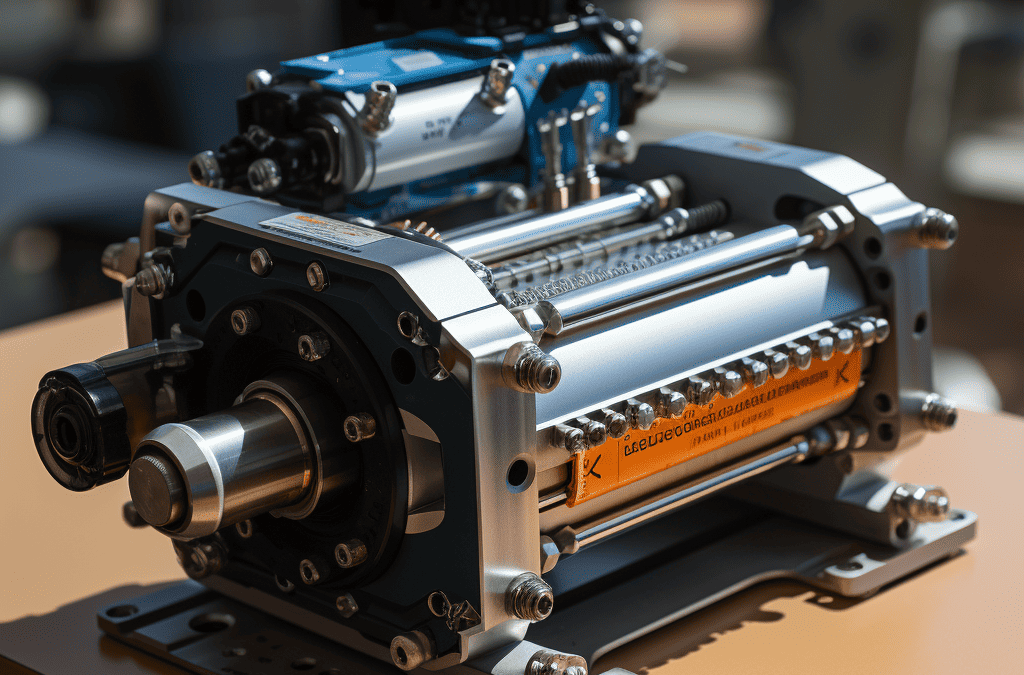
Images are fictional.

How Pneumatic Actuators Transmit Rotary Motion
Pneumatic actuators are devices that convert compressed air into mechanical motion. They are commonly used in industrial automation for controlling valves, pumps, and other machinery. While linear actuators are the most common type of pneumatic actuator, rotary actuators are also widely used in applications that require rotational motion. In this blog post, we will discuss the basic principles of pneumatic actuators, the working mechanism of rotary pneumatic actuators, the types of rotary pneumatic actuators, their advantages, and their applications.
The Basic Principles of Pneumatic Actuators
Pneumatic actuators use compressed air to generate mechanical motion. The compressed air is stored in a reservoir and then released through a valve to the actuator. The actuator consists of a cylinder or a vane that is connected to a piston or a rod. When the compressed air is released, it pushes against the piston or the rod, causing it to move. The movement of the piston or the rod is then used to control the valve, pump, or other machinery.
The Working Mechanism of Rotary Pneumatic Actuators
Rotary pneumatic actuators work by converting the linear motion of compressed air into rotary motion. This is achieved through the use of a vane or piston arrangement that is mounted on a central shaft. As air pressure is applied to the vane or piston, it causes the shaft to rotate. The amount of rotation depends on the design of the actuator and the pressure applied.
There are two main types of rotary pneumatic actuators: rack and pinion, and vane. Rack and pinion actuators use a gear arrangement to convert linear motion into rotary motion. Vane actuators use a series of vanes mounted on a central shaft to provide rotary motion. Both types of actuators have their advantages and disadvantages, and the choice between them depends on the specific application.
Types of Rotary Pneumatic Actuators
Rack and Pinion Actuators
Rack and pinion actuators are the most common type of rotary pneumatic actuator. They use a gear arrangement to convert linear motion into rotary motion. The rack is a linear gear that meshes with a circular gear, or pinion, to create rotary motion. Rack and pinion actuators are suitable for applications that require high torque and low speed.
Vane Actuators
Vane actuators use a series of vanes mounted on a central shaft to provide rotary motion. As air pressure is applied to the vanes, they move in a circular motion, causing the shaft to rotate. Vane actuators are suitable for applications that require low torque and high speed.
Double-Acting Actuators
Double-acting actuators use compressed air to move the piston or vane in both directions. They are suitable for applications that require precise control over the movement of the valve or machinery.
Spring Return Actuators
Spring return actuators use a spring to return the piston or vane to its original position when the compressed air is released. They are suitable for applications that require rapid cycling of the valve or machinery.
The Advantages of Rotary Pneumatic Actuators
Rotary pneumatic actuators offer several advantages over other types of actuators. They are highly reliable, with few moving parts that can wear out or fail. They are also compact and lightweight, making them easy to install and maintain. Additionally, they can provide high torque output and fast response times, making them ideal for applications that require precise control.
Another advantage of rotary pneumatic actuators is their ability to operate in harsh environments. They are resistant to dust, dirt, and moisture, making them suitable for use in outdoor or dirty applications. They are also immune to electrical interference, which makes them ideal for use in hazardous environments where sparks could ignite flammable materials.
The Applications of Rotary Pneumatic Actuators
Rotary pneumatic actuators are used in a wide range of industrial applications, including robotics, packaging, and material handling. They are also commonly used in automotive manufacturing to control the movement of conveyor belts and assembly lines. In addition, they are used in the food and beverage industry for applications such as bottling and canning.
One example of a rotary pneumatic actuator application is in robotic arms used for assembly or pick-and-place operations. These actuators provide precise control over the movement of the arm, allowing it to move in multiple directions and rotate to pick up objects.
Another example is in the packaging industry, where rotary pneumatic actuators are used to control the movement of conveyor belts and product handling equipment. They provide fast and accurate movement, which helps to increase productivity and reduce downtime.
Rotary pneumatic actuators offer several advantages in industrial automation and control applications:
- High Torque: They can generate high torque at low speeds, which is essential for controlling heavy machinery and valves.
- Rapid Response: These actuators respond quickly to control signals, enabling fast and precise adjustments in process control systems.
- Durability: Designed for reliability, rotary pneumatic actuators can withstand harsh industrial environments and operate reliably with minimal maintenance.
- Cost-Effective: Compared to electric and hydraulic actuators, pneumatic actuators are generally more cost-effective, especially in applications requiring a simple motion or where compressed air is readily available.
- Safety: They are inherently safe for use in explosive or flammable atmospheres since they do not generate sparks and can be operated in environments where electrical equipment might pose a risk.
- Versatility: Rotary pneumatic actuators can be adapted for a wide range of applications, from simple valve actuation to complex automation systems, thanks to the variety of types and configurations available.
Choosing the Right Rotary Pneumatic Actuator
When selecting a rotary pneumatic actuator for a specific application, there are several factors to consider. These include the required torque, speed, and environmental conditions. Rack and pinion actuators are generally better suited for applications that require high torque and low speed, while vane actuators are better suited for applications that require high speed and low torque.
It is also important to consider the operating environment of the actuator. For example, if the actuator will be used in a dusty or dirty environment, it is important to choose an actuator that is resistant to these conditions. Similarly, if the actuator will be used in a hazardous environment, it is important to choose an actuator that is immune to electrical interference.
Actuator Mounting Options
Actuator mounting options are also an important consideration. Clevis mounts are the most common type of mount, allowing for easy installation and adjustment. Trunnion mounts provide greater stability and are suitable for applications that require high torque or thrust.
Position Feedback Options
Position feedback options are also important for applications that require precise control. Limit switches and encoders are commonly used to provide position feedback. Limit switches provide basic on/off feedback, while encoders provide more detailed position information.
Maintenance and Repair Considerations
Proper maintenance and repair of rotary pneumatic actuators is essential to ensure their reliable operation. Regular inspection and lubrication of the actuator components can help to prevent wear and extend the life of the actuator. Additionally, it is important to address any issues with the compressed air system that may be affecting the performance of the actuator.
Industry-Specific Applications
Rotary pneumatic actuators are used in a wide range of industries, including pharmaceutical, oil and gas, and aerospace. In the pharmaceutical industry, they are used to control the movement of mixers and blenders. In the oil and gas industry, they are used to control the movement of valves and pumps. In the aerospace industry, they are used to control the movement of landing gear and flaps.
Applications of Rotary Pneumatic Actuators
Rotary pneumatic actuators find applications across various industries, including:
- Valve Operation: In the oil and gas, water treatment, and chemical processing industries, they are used to control the opening and closing of ball, butterfly, and plug valves.
- Material Handling: For automated conveyor systems, sorting mechanisms, and packaging machines, providing precise control and movement.
- Manufacturing: In assembly lines, press operations, and robotic arms for tasks requiring rotational movement.
- Automotive: In production lines for tasks like screw driving, pressing, and handling components.
- Food and Beverage: In processing equipment for mixing, blending, and packaging operations where cleanliness and speed are essential.
Rotary pneumatic actuators are integral to modern industrial automation, offering efficient, reliable, and cost-effective solutions for a wide range of motion control applications. Their adaptability to different environments and operational requirements makes them invaluable in enhancing efficiency and productivity in industrial processes.
Rotary pneumatic actuators offer many advantages for industrial automation applications that require rotational motion. By understanding the basic principles of pneumatic actuators and the working mechanism of rotary pneumatic actuators, you can choose the right type of actuator for your specific application. By considering factors such as torque, speed, and environmental conditions, you can ensure reliable and precise operation of your machinery.

Understanding the components of a rotary pneumatic actuator is essential for selecting the right actuator for your specific application and ensuring optimal performance. Here are the key components of a rotary pneumatic actuator:
1. Housing: The housing is the outer shell of the actuator that protects the internal components. It is typically made of aluminum or steel and is designed to be rugged and durable.
2. Rotor: The rotor is the central component of the actuator that rotates to produce the desired motion. It is connected to the output shaft and is driven by the vane assembly.
3. Vane Assembly: The vane assembly consists of several vanes that are mounted on the rotor. These vanes move within the cylindrical chamber, creating a pressure differential that generates torque and causes the rotor to rotate.
4. Air Inlet and Outlet: The air inlet and outlet are the ports where compressed air enters and exits the actuator. The air inlet is typically located on the side of the housing, while the air outlet is located on the opposite side.
5. Bearings: The bearings support the rotor and allow it to rotate smoothly and efficiently. They are typically made of high-quality materials such as stainless steel or ceramic.
6. Limit Switches: Limit switches are used to control the actuator’s movement and prevent it from rotating beyond its designed range of motion. They are typically located on the housing and are activated by the rotor as it approaches the end of its travel.
7. Mounting Brackets: Mounting brackets are used to attach the actuator to the mechanical system it is controlling. They are typically made of metal and are designed to be strong and durable.
In addition to these components, rotary pneumatic actuators may also include other features such as position feedback sensors, manual override mechanisms, and adjustable air pressure regulators.
When selecting a rotary pneumatic actuator, it is important to consider factors such as the required torque and speed, the operating environment, and the desired level of precision and control. By understanding the components of a rotary pneumatic actuator and selecting the right actuator for your application, you can ensure optimal performance and reliability for your industrial automation system.

Temperature and Environmental Conditions
Extreme temperatures: The performance of a rotary pneumatic actuator can be affected by extreme temperatures, both high and low. High temperatures can cause the seals and other components to degrade, leading to leaks and reduced efficiency. Low temperatures can cause the compressed air to condense, leading to the formation of ice and water in the system, which can cause damage to the actuator.
Environmental factors: In addition to temperature, environmental factors such as humidity, dust, and corrosive substances can also affect the performance of a rotary pneumatic actuator. It is essential to select an actuator that is designed to withstand the specific environmental conditions of the application.
Actuator Design and Configuration
Size and shape: The size and shape of the actuator can also affect its performance. A larger actuator will generally provide more torque and force than a smaller one, but it may also be more expensive and require more space. The shape of the actuator can also affect its performance, as some shapes are better suited for certain applications than others.
Mounting options: The mounting options of the actuator can also affect its performance. Different mounting configurations can change the actuator’s center of gravity and moment of inertia, which can affect its ability to generate torque and rotate at high speeds.
Maintenance and Lubrication
Regular maintenance: Regular maintenance is crucial in ensuring the optimal performance and reliability of a rotary pneumatic actuator. This includes inspecting the actuator for wear and damage, replacing worn or damaged parts, and cleaning and lubricating the actuator as needed.
Lubrication: Proper lubrication is essential in reducing friction and wear in the actuator’s moving parts. It is recommended to use a high-quality lubricant that is designed for pneumatic systems, and to follow the manufacturer’s recommendations for lubrication frequency and volume.
Actuator Control and Feedback
Position control: The ability to control the position and speed of the actuator is critical in many applications. This can be achieved through the use of feedback devices such as encoders and limit switches, which provide information on the actuator’s position and movement.
Control systems: The control system used to operate the actuator can also affect its performance. A well-designed control system can optimize the actuator’s performance, reduce energy consumption, and improve overall system reliability.
Several factors can affect the performance of a rotary pneumatic actuator, including compressed air quality, operating pressure and flow rate, load characteristics, temperature and environmental conditions, actuator design and configuration, maintenance and lubrication, and actuator control and feedback. By understanding these factors and taking appropriate measures to address them, it is possible to ensure optimal performance and reliability in pneumatic actuator rotary motion applications.

Common Applications of Rotary Pneumatic Actuators in Industrial Settings
Rotary pneumatic actuators are versatile and reliable devices that provide rotary motion in a wide range of industrial applications. By understanding the factors that affect their performance and selecting the appropriate actuator for the specific application, it is possible to achieve optimal performance and reliability.
Process Control
Rotary pneumatic actuators are commonly used in process control applications to control valves and dampers in manufacturing plants, power generation facilities, and other industries. These actuators provide precise and reliable control of the flow of fluids or gases, which is critical for maintaining optimal process conditions. For example, rotary pneumatic actuators are used in the oil and gas industry to control the flow of crude oil and natural gas through pipelines, as well as in the chemical industry to control the flow of chemicals and other raw materials through production processes.
Material Handling
Rotary pneumatic actuators are also used in material handling applications to provide the rotary motion required to move and position materials. This is essential for automated production processes, such as conveyor systems, robotic arms, and packaging machinery. For example, rotary pneumatic actuators are used in the automotive industry to move and position car bodies on assembly lines, as well as in the food and beverage industry to move and position containers on packaging lines.
Motion Control
In motion control applications, rotary pneumatic actuators provide precise and reliable control of rotary motion, which is essential for accurate positioning and movement of components. For example, rotary pneumatic actuators are used in automated guided vehicles (AGVs) to control the movement of the vehicles, as well as in robotic systems to control the movement of robotic arms. Additionally, rotary pneumatic actuators are used in medical equipment, such as imaging machines and surgical robots, to provide precise and reliable motion control.
Test and Measurement
Rotary pneumatic actuators are also used in test and measurement applications to provide precise and repeatable motion for testing and calibrating equipment. This is essential for ensuring the accuracy and reliability of the equipment. For example, rotary pneumatic actuators are used in the aerospace industry to test and calibrate aircraft components, as well as in the automotive industry to test and calibrate vehicle components. Additionally, rotary pneumatic actuators are used in laboratory equipment, such as microscopes and spectrometers, to provide precise and reliable motion control.
Food and Beverage Processing
In food and beverage processing applications, rotary pneumatic actuators provide the rotary motion required to move and position containers, which is essential for automated production processes. Additionally, rotary pneumatic actuators can be designed to meet the specific sanitary requirements of the food and beverage industry. For example, rotary pneumatic actuators are used in packaging machinery and bottling plants to move and position containers, as well as in food processing equipment to control the movement of food products through production processes.
Note: Rotary pneumatic actuators are versatile and reliable devices that are used in a wide range of industrial applications. By understanding the factors that affect their performance and selecting the appropriate actuator for the specific application, it is possible to achieve optimal performance and reliability.


