
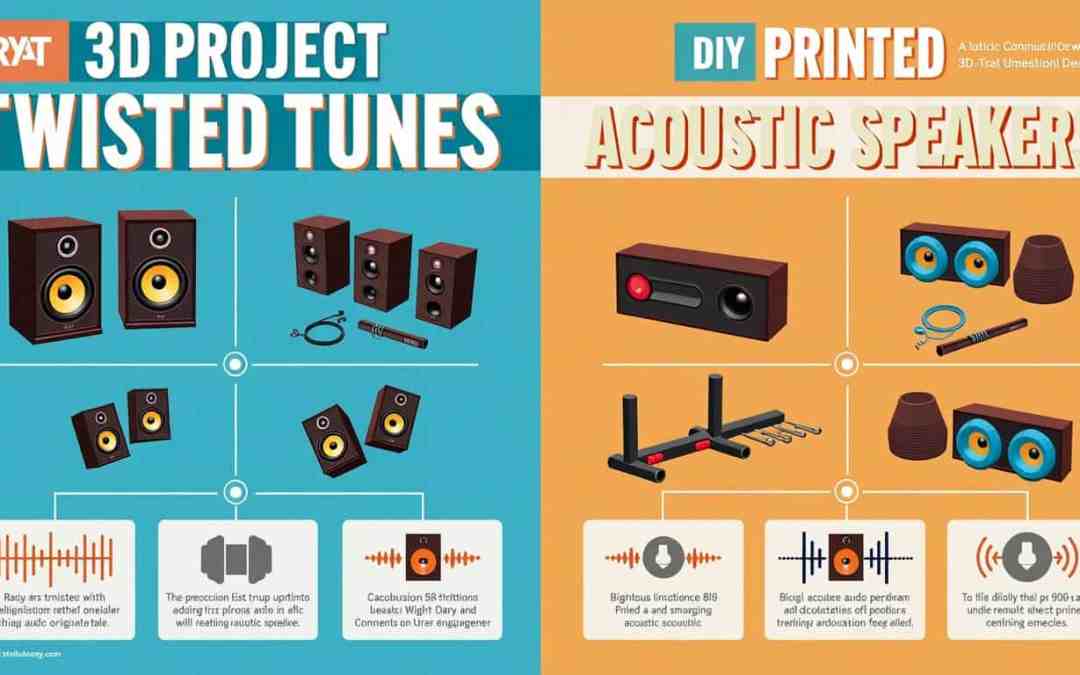
A Comparative Exploration: Project Twisted Tunes vs. 3D Printed Acoustic Speakers
Introduction
Engaging Opening
In the ever-evolving world of audio technology, innovation is a constant pursuit. As technology enthusiasts and audiophiles seek out the next big leap in speaker design, two fascinating projects have emerged: Project Twisted Tunes and 3D Printed Acoustic Speakers. Both leverage cutting-edge technology, yet they offer distinct approaches to crafting high-quality audio experiences.
Introducing Both Ideas
Project Twisted Tunes showcases a blend of traditional acoustic design with modern 3D printing techniques, focusing on bespoke speaker construction for the discerning audiophile. In contrast, 3D Printed Acoustic Speakers emphasize customization and accessibility, empowering DIY builders to create bespoke audio systems with ease.
State Objective
This post aims to provide a comprehensive comparison between Project Twisted Tunes and 3D Printed Acoustic Speakers, helping audiophiles, DIY enthusiasts, and the maker community navigate these innovative audio solutions.
Performance Showdown: Which Idea Delivers More?
Idea A: Project Twisted Tunes
Project Twisted Tunes delivers impressive performance through its horn-like box design, promoting efficient soundwave direction and superior acoustic precision. Tools like FEMM and REW ensure meticulous fine-tuning, resulting in clear, crisp audio across a wide frequency range.
Idea B: 3D Printed Acoustic Speakers
3D Printed Acoustic Speakers excel in flexibility, enabling designs that offer flat frequency responses and minimized resonance. The freedom to incorporate custom waveguides and passive radiators allows users to optimize acoustic performance to their preferences.
Key Takeaways
Project Twisted Tunes focuses on high-fidelity sound through traditional engineering enhanced by 3D printing, while 3D Printed Acoustic Speakers prioritize design flexibility and user-driven customization.
User Experience: Navigating Ease of Use
Idea A: Project Twisted Tunes
With a modular design, Project Twisted Tunes offers ease of assembly, maintenance, and customization, catering to users familiar with DIY audio projects. The precise alignment required for optimal sound might pose a learning curve for newcomers.
Idea B: 3D Printed Acoustic Speakers
The 3D Printed Acoustic Speakers‘ user experience revolves around customization. Casual builders appreciate pre-designed models, with online resources easing the learning curve for beginners. Serious audiophiles can delve into detailed crossover and design adjustments.
Key Takeaways
Project Twisted Tunes demands a deeper understanding of audio assembly, whereas 3D Printed Acoustic Speakers offer a more accessible entry point for DIY enthusiasts with robust customization options.
Cost Analysis: Getting the Best Value
Idea A: Project Twisted Tunes
Project Twisted Tunes may involve a higher initial investment due to the use of advanced materials and precision engineering. However, its performance and customization potential can offer significant value for dedicated audiophiles.
Idea B: 3D Printed Acoustic Speakers
For budget-conscious builders, 3D Printed Acoustic Speakers can be more cost-effective, with 3D printing reducing manufacturing expenses. Yet, high-quality drivers and components still contribute to the overall cost.
Key Takeaways
Though Project Twisted Tunes might be more expensive, its bespoke quality appeals to audiophiles. Meanwhile, 3D Printed Acoustic Speakers offer more economical options for DIY enthusiasts.
Long-Term Support: Reliability Over Time
Idea A: Project Twisted Tunes
With components sourced from PCBWay and 3D printing partners, Project Twisted Tunes provides robust support through quality materials and ongoing community engagement.
Idea B: 3D Printed Acoustic Speakers
The vibrant DIY audio community and resources like Thingiverse offer substantial support and updates, though users must rely on individual successes and collaborations for problem-solving.
Key Takeaways
Both ideas thrive with community support, yet Project Twisted Tunes benefits from professional component sourcing, while 3D Printed Acoustic Speakers tap into open-source collaboration.
Putting Ideas Into Practice
Idea A: Project Twisted Tunes
Ideal for audiophiles, Project Twisted Tunes finds use in bespoke audio setups, home studios, and maker workshops focused on high-quality sound engineering.
Idea B: 3D Printed Acoustic Speakers
These speakers cater to home theaters, casual DIY projects, and educational contexts, demonstrating versatility in real-world applications.
Key Takeaways
Both projects have diverse applications, with Project Twisted Tunes excelling in specialized setups and 3D Printed Acoustic Speakers offering broader DIY accessibility.
Weighing the Advantages and Disadvantages
Idea A: Project Twisted Tunes
- Pros:
- Superior acoustic precision
- Modular and customizable
- High-quality components
- Cons:
- Higher cost
- Complexity in assembly and alignment
Idea B: 3D Printed Acoustic Speakers
- Pros:
- Design flexibility
- Cost-effective for DIY projects
- Easy access to designs and tutorials
- Cons:
- Potential cost of high-quality drivers
- Requires careful tuning for optimal performance
Key Takeaways
Choose Project Twisted Tunes for high-quality, precision audio and 3D Printed Acoustic Speakers for flexibility and cost-effectiveness.
Final Verdict: Choosing the Right Idea for You
Summary
Project Twisted Tunes and 3D Printed Acoustic Speakers both redefine speaker innovation with 3D printing at their core. While the former offers unmatched acoustic precision, the latter emphasizes design freedom and community support.
Recommendations
For audiophiles seeking top-notch sound and customization, Project Twisted Tunes is the ideal choice. Conversely, DIY enthusiasts will find compatibility and cost-effective options in 3D Printed Acoustic Speakers.
Call to Action
Join the conversation: share your experiences with these projects, or explore further resources to deepen your knowledge about innovative speaker design.


