
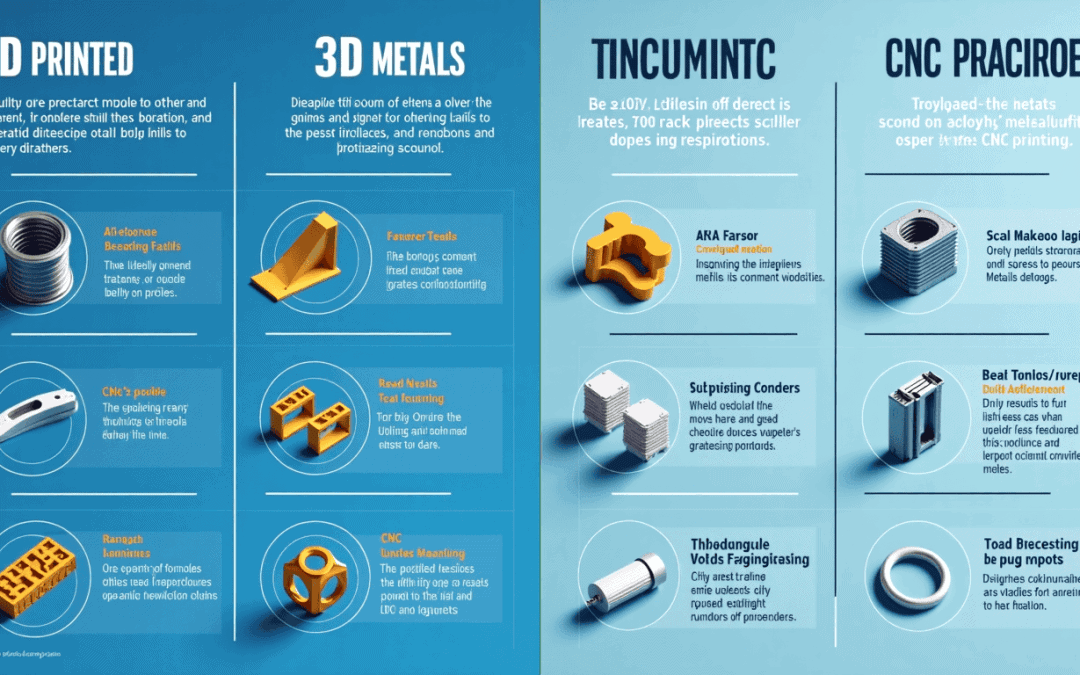
Comparative Analysis of 3D Printed Metals vs. Plastics and CNC Machining vs. 3D Printing
Introduction
In today’s rapidly evolving manufacturing landscape, discerning the right material and production method is critical for engineers, hobbyists, and business professionals. Whether you’re enhancing aerospace components or crafting consumer electronics, understanding the nuances of material properties and manufacturing processes can drive innovation and cost-effectiveness. This blog post delves into two pivotal comparisons: 3D printed metals versus plastics, and CNC machining versus 3D printing, offering insights into performance, usability, cost, support, and practical applications.
Table of Key Differences
| Feature | 3D Printed Metals | 3D Printed Plastics | CNC Machining | 3D Printing |
|---|---|---|---|---|
| Material Strength | High | Moderate | Very High | Moderate |
| Cost | High | Low | Varies | Moderate |
| Complexity Handling | Moderate | High | Low | Very High |
| Production Volume | Low-Mid | Low-Mid | High | Low-Mid |
| Support & Updates | Extensive (Metal-specific) | Moderate | Extensive | Moderate |
Section 1: Performance Showdown: Which Material or Method Delivers More?
3D Printed Metals vs. Plastics
3D printed metals, using processes like DMLS or DMLM, deliver components with exceptional strength and density, suitable for high-stress environments like aerospace or medical industries. Common alloys, from stainless steel to cobalt chrome, offer diverse mechanical properties tailored to specific requirements. Conversely, plastic 3D printing, often via FFF or SLS, provides materials with advantageous strength-to-weight ratios and cost efficiencies, albeit with reduced tensile strength compared to metals.
CNC Machining vs. 3D Printing
CNC machining offers unchallenged material strength, leveraging the full mechanical potential of raw materials. Fast and efficient for large-scale production, CNC machining is ideal for straightforward geometries. In contrast, 3D printing excels in design complexity, allowing rapid prototyping and the creation of intricate structures, though with potential compromises in material integrity and speed.
Key Takeaways: Choose 3D printed metals for maximum strength, CNC machining for precision and volume, and 3D printing for design complexity and customization.
Section 2: User Experience: Navigating Ease of Use
3D Printed Metals vs. Plastics
Metal 3D printing requires complex processes and environments, demanding specialized knowledge and post-processing. Plastic 3D printing, however, is accessible and versatile, ideal for rapid iteration and prototyping with minimal setup.
CNC Machining vs. 3D Printing
CNC machining requires skilled operation and significant initial setup but offers consistent results once initialized. 3D printing, conversely, demands minimal setup, offering adaptability and ease of change across design iterations.
Key Takeaways: For user accessibility and minimal setup, plastics and 3D printing are preferable. Metals and CNC require more specialized handling.
Section 3: Cost Analysis: Getting the Best Value
3D Printed Metals vs. Plastics
Metal 3D printing is expensive, driven by material costs and post-processing requirements. Conversely, plastic 3D printing proves cost-effective, especially in applications with moderate mechanical demands.
CNC Machining vs. 3D Printing
While CNC machining’s initial setup can be costly, it becomes economical at scale. 3D printing provides consistent pricing, advantageous for bespoke or low-volume items.
Key Takeaways: Plastics and 3D printing provide financial advantages for prototyping and low-volume scenarios, whereas metals and CNC machining optimize value in high-stress or large-scale applications.
Section 4: Long-Term Support: Reliability Over Time
3D Printed Metals vs. Plastics
Metal additive manufacturing benefits from extensive support, driven by industry standards and continuous innovation. Plastics, while offering a broad range of options, provide moderate support.
CNC Machining vs. 3D Printing
CNC machining is backed by robust industry support and established practices. 3D printing offers moderate updates, with diverse providers enhancing adaptability.
Key Takeaways: Metals and CNC machining stand out for comprehensive support and reliability, vital for industrial applications.
Section 5: Putting Ideas Into Practice
3D Printed Metals vs. Plastics
Metals excel in sectors like aerospace and medical, where strength and durability are paramount. Plastics shine in consumer goods and rapid prototypes, offering economical versatility.
CNC Machining vs. 3D Printing
CNC machining supports the automotive and aerospace industries with precise, high-strength components. 3D printing aids rapid product development in various sectors, including medical and consumer markets.
Key Takeaways: Align material and process choice with industry demands and product requirements for optimal application efficacy.
Section 6: Weighing the Advantages and Disadvantages
3D Printed Metals
Pros: High strength, durability, exceptional material properties
Cons: Costly, complex, and labor-intensive
3D Printed Plastics
Pros: Cost-effective, versatile, easy to iterate
Cons: Lower strength, limited in high-stress applications
CNC Machining
Pros: High strength, precision, scalability
Cons: Costly setup, limited design freedom
3D Printing
Pros: Design freedom, rapid prototyping, adaptable
Cons: Compromises in strength, potential for slow production
Key Takeaways: Evaluate the trade-offs between strength, cost, design freedom, and scalability to make informed decisions.
Conclusion: Final Verdict: Choosing the Right Idea for You
Choosing between 3D printed metals or plastics and CNC machining or 3D printing hinges on specific project needs, material demands, and production scales. Metals and CNC machining offer strength and support for industrial applications, while plastics and 3D printing deliver versatility and cost-efficiency, catering to innovation and prototyping. We recommend thoroughly assessing your project’s requirements, leveraging the unique strengths of each material and process to align with your manufacturing goals. Engage with industry experts and service providers to refine your choices and achieve optimal manufacturing outcomes.
Feel free to leave comments, share your experiences, or explore additional resources as you navigate the fascinating world of modern manufacturing technologies!


